Peaceful Realism
LEARNING TO SEE
What Is Peaceful Realism?
The Story Behind the Way I Paint
By Debra Davis
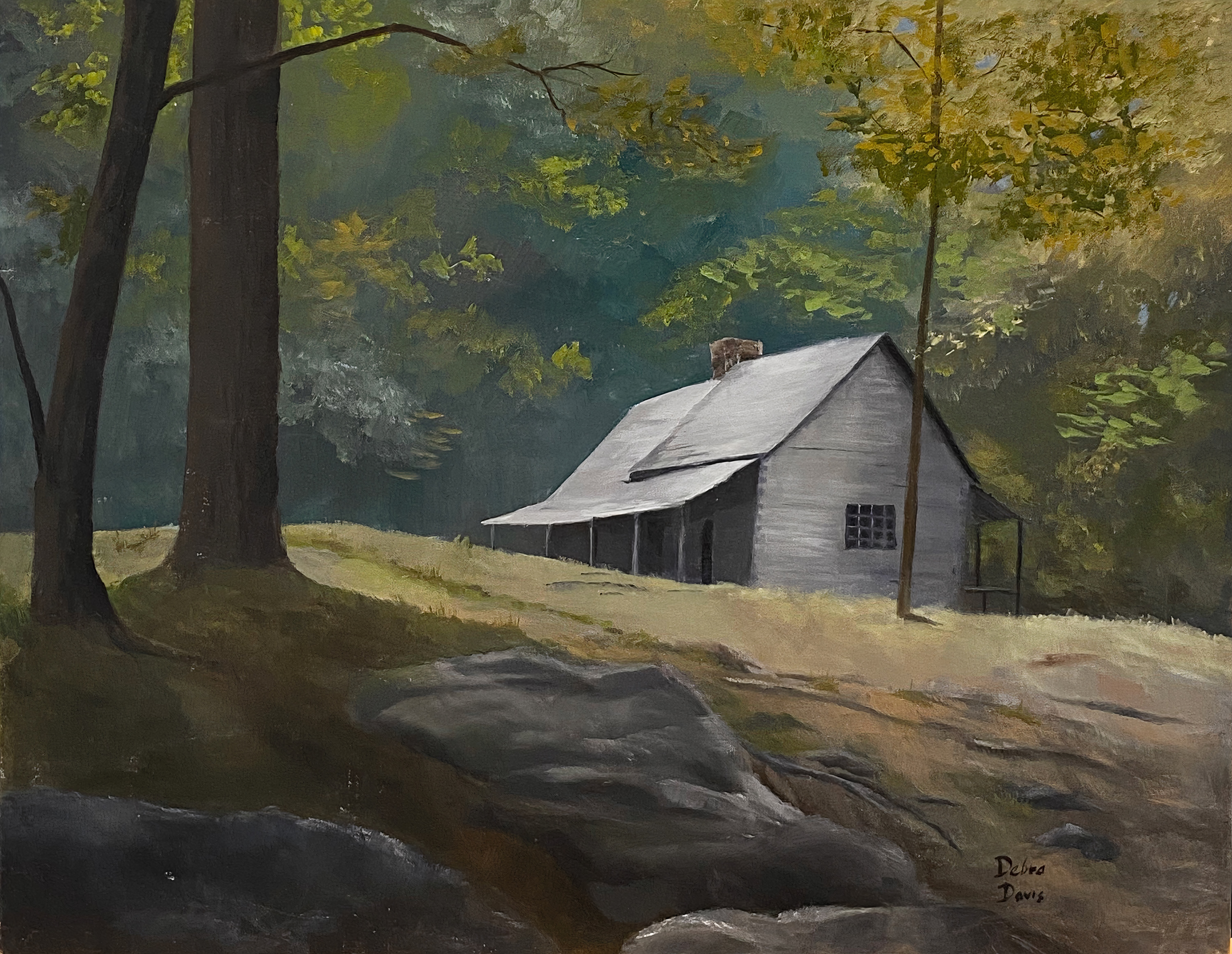
Peaceful Hideaway, oil on canvas, Debra Davis
I call the way I paint Peaceful Realism.I didn't set out to create an art movement or come up with a clever name for my work. I simply needed words for the way I had already been painting for years.
I'm drawn to quiet, everyday scenes—a field catching the morning light, flowers in a room, a familiar landscape, a few simple objects arranged on a table. Things we could easily walk past without really seeing.
But every now and then, something makes me stop.
Maybe it's the light. Maybe it's an unexpected color. Maybe it's a familiar place that suddenly looks different for just a moment.
I want to capture that moment in paint.
And then I want something else to happen.
I want the finished painting to draw you closer.
From across the room, you might notice the light, color or subject first. But when you step closer, I want you to discover the layers, subtle details, brushwork and little passages you couldn't see from a distance.
I want you to keep looking.
And maybe, somewhere in that looking, have that wonderful moment when you think:
“Wow. How did she do that?”
That's Peaceful Realism.
“Paintings of Places Worth Remembering.”
— Debra Davis
✦—✦
What Is Peaceful Realism?
Peaceful Realism is the name I give to my slow, observational style of oil painting.
It isn't an established school or art movement. It's simply the best way I've found to describe how I see and how I paint.
I work carefully and slowly, building my paintings in layers of oil paint over days and weeks. I'm interested in realism, but I'm not trying to reproduce every detail as though I were copying a photograph.
I'm trying to hold onto what made me notice the subject in the first place.
The way morning light falls across a field.
The turn of a flower.
A reflection you almost missed.
The way one edge disappears into shadow.
A familiar place that suddenly looks beautiful.
Those are the things that make me want to paint.
My subjects are often simple on purpose. I don't believe a painting has to be loud to have an impact.
Sometimes the quietest painting in a room is the one that keeps calling you back.
✦—✦
Why Do I Call It “Peaceful” Realism?
For me, “peaceful” doesn't mean there's nothing happening in the painting.
And it doesn't mean every painting has to depict a perfectly tranquil scene.
It describes something closer to the experience of slowing down long enough to really look.
We move through so much of our lives quickly. We pass the same fields, trees, flowers, rooms and familiar places without noticing very much about them.
Painting makes me stop.
It makes me study the light. Notice a color I hadn't seen before. Pay attention to an edge, a shadow, a reflection or the way one object sits beside another.
Because a painting can take several weeks to complete, I stay with those observations for a long time.
I think some of that stillness remains in the finished painting.
But I also want there to be discovery.
Peaceful Realism should invite you to slow down, but then it should give you something for your attention.
The closer you look, the more I want you to find.
That's the “peaceful” part of Peaceful Realism for me. It isn't emptiness.
It's attention.
✦—✦
Why Do I Want You to Look Closer?
Because some of the most interesting parts of an original oil painting aren't the things you see first.
From several feet away, a painting has to work as a whole. You might notice the light across a landscape, the shape of the flowers or the arrangement of a still life.
Then you move closer.
That's when another painting begins to appear.
You start seeing the layers of color. A tiny change in temperature. An edge that seemed perfectly defined from across the room but is actually just a few carefully placed brushstrokes.
You may find a detail you hadn't noticed at all.
I love that experience with paintings, and it's something I want to create in my own work.
I want the realism to make you curious enough to come closer.
Then I want the painting itself to reward you for making the trip.
That moment of discovery matters to me.
I want you to wonder how paint became light, distance, glass, a flower petal or morning air.
And yes, I'd love for you to stand there every once in a while and think:
“Wow. How did she do that?”
✦—✦
Is Peaceful Realism the Same as Photorealism?
No.
Photorealism generally aims to reproduce the appearance of a photograph with extraordinary precision. That's not what I'm trying to do.
I use careful observation and reference as part of my process, but I'm making artistic decisions all the way through the painting.
What deserves more attention?
What can become quieter?
Where should the light lead your eye?
Which edge needs to disappear?
Where do I want you to look first—and what might you discover when you look again?
Those decisions are part of the painting.
If you stand close to one of my originals, I don't want you to see a perfectly smooth photographic surface.
I want you to see that a person painted it.
You'll find brushwork. Layers. Texture. Transparent passages beside more opaque ones. Subtle shifts of color that come together differently when you step back.
That's one of the things I love most about realism in oil paint.
Up close, you can see paint.
Step back, and somehow it becomes something else.
✦—✦
Why Does a Peaceful Realism Painting Take Several Weeks?
I paint slowly and in layers.
Rather than trying to finish an oil painting in one or two sittings, I gradually build the color, form, depth and light.
Each layer needs time.
Some areas need to dry before I can work over them. Other areas change because I come back, look again and realize something isn't quite right yet.
Sometimes the smallest adjustment makes the difference.
That slow build is especially important to the way I paint light.
A single color placed on the surface can be beautiful. But layers allow earlier colors to influence what comes afterward. That can create a depth and luminosity that's difficult to appreciate fully in a photograph of the painting.
It's one reason I always love when someone gets to see my work in person.
The closer you get, the more you can see how the painting was built.
Working this way also means I can only complete so many original paintings each year.
I'm comfortable with that.
I don't want to rush a painting simply so I can finish another one.
Slow is part of the work.
✦—✦
Why Paint Ordinary Places and Things?
Because ordinary doesn't mean unimportant.
Some of the places that matter most to us aren't famous places.
They're the road we've driven a hundred times.
The field we pass on the way home.
Flowers sitting near a window.
A familiar landscape.
A table holding objects that somehow remind us of another time or another person.
These things become part of the background of our lives.
Sometimes we don't realize how much they mean until something changes.
That's one reason I'm drawn to everyday subjects. I'm interested in the beauty that's already there—the beauty we might miss because we've become accustomed to seeing it.
Painting gives me a reason to stop.
And perhaps when you see the finished painting, it gives you a reason to stop too.
That's part of what Learning to See means to me.
It's looking past the obvious.
It's noticing what you almost missed.
It's discovering that an ordinary moment can be extraordinary when you really pay attention.
✦—✦
How Does Peaceful Realism Feel in a Home?
I believe original art should be something you can live with.
I don't paint with the goal of matching a decorating trend that may disappear in a few years. I want to create paintings that still feel like themselves long after the room around them has changed.
Furniture gets replaced.
Walls get painted.
Styles come and go.
But a painting you truly connect with can stay with you through all of it.
I especially love the idea of a painting revealing itself slowly in a home.
You see it every day, but you don't necessarily experience it the same way every day.
Morning light may bring out something you hadn't noticed.
You may walk past it one afternoon and suddenly see a detail differently.
A visitor may notice something you've never noticed before.
That's the kind of relationship I want my paintings to have with the people who live with them.
Not simply something pretty filling a space on the wall.
Something worth looking at again.
✦—✦
Does Peaceful Realism Work in a Modern Home?
Absolutely.
I don't believe you need a traditionally decorated home to live with realistic art.
In fact, I love the relationship between a quiet, detailed painting and a simpler modern room. A landscape, floral or still life can bring depth and warmth to clean lines and open spaces without making the room feel busy.
But I also don't believe you should choose original art simply because it matches your sofa.
When you're considering a painting, I'd rather you ask:
“How does this make me feel?”
“What keeps drawing me back?”
and perhaps most importantly:
“Do I want to keep looking at this?”
If the answer is yes, pay attention to that.
✦—✦
Do You Have to Be an Art Collector to Buy Original Art?
Not at all.
You don't have to call yourself a collector.
You don't have to know art terminology.
And you certainly don't have to understand everything about oil painting technique before you're “qualified” to own an original painting.
Sometimes you simply connect with a piece.
You keep coming back to it.
You notice something new.
You start imagining where you would put it.
That's enough.
There's also something very different about standing in front of an original oil painting instead of seeing it on a screen.
You can see the physical surface created by the artist. Brushstrokes catch the light. Some layers are thicker while others are almost transparent. Colors shift subtly as you move closer.
There will only ever be that one original.
I think that's part of what makes living with original art so personal.
✦—✦
Where Can You See My Paintings in Auburn/Opelika, AL?
I'm an Alabama oil painter based in Cusseta, near Auburn/Opelika, AL, and you can see some of my work in person at Auburn/Opelika Tourism.
I'm especially glad to have my paintings somewhere people can experience them in person because photographs only tell part of the story.
When you stand in front of an original oil painting, you can move closer and see the layers, brushwork, subtle color changes and details that can disappear on a screen. Then you can step back and watch those individual marks come together again.
That's a big part of Peaceful Realism for me.
I've also participated in juried exhibitions in the area and won Best of Show at my first juried exhibition. I've since received four awards in juried shows.
I'm grateful for those honors.
But there's another reaction that means a great deal to me.
It's when someone moves closer to one of my paintings.
They look.
Then they look a little longer.
Maybe they point out a detail or ask, “How did you do that?”
That's when I know the painting has done what I hoped it would do.
It made someone want to see more.
✦—✦
The Bottom Line
Peaceful Realism isn't a trend.
It's the name I've given to a way of painting that developed naturally over years of working slowly, observing carefully and learning to pay attention.
I paint realistic subjects because I'm fascinated by the recognizable world around us.
I paint slowly because looking takes time.
I paint in layers because I want light, depth and detail to reveal themselves gradually.
And I paint ordinary places and moments because I've learned that ordinary doesn't mean unimportant.
I want a painting to draw you in from across the room.
Then I want you to come closer.
Look again.
Notice something you didn't see the first time.
And maybe wonder how a little oil paint on canvas somehow became light, distance, atmosphere, flowers or a place you suddenly feel you know.
That's what I'm reaching for with Peaceful Realism.
Look closer. There's more to see.
Peaceful Realism
Paintings of Places Worth Remembering.
— Debra Davis
✦—✦
Frequently Asked Questions
Is Peaceful Realism an established art movement?
No. Peaceful Realism is the name I use to describe my own approach to oil painting. It combines careful observation, realistic subjects and a slow, layered painting process with my interest in everyday places and moments worth remembering.
Is Peaceful Realism the same as photorealism?
No. My goal isn't to copy a photograph exactly. I make artistic decisions throughout the painting about color, light, edges, detail and emphasis. When you look closely at one of my original paintings, you can still see brushwork, layers and evidence of the painting process.
Why do your paintings take so long to finish?
Most take several weeks because I build them gradually in layers of oil paint. Some layers need time to dry before I can continue working over them. The slower process also gives me time to keep looking, evaluating and making the small adjustments that create depth and light.
Why is it better to see an original oil painting in person?
A photograph or screen can't fully reproduce the physical surface of an original oil painting. In person, you can see brushwork, texture, transparent and opaque layers, subtle color changes and the way light interacts with the paint. Those details are part of the experience I want viewers to discover when they look closer.
Do I need a large wall for original art?
No. A small original painting can have just as much presence in the right place as a large painting. What matters more is the relationship between the painting, the space and the person who will live with it.
Do I need to know about art before buying an original painting?
No. Your response to the painting matters. If you find yourself returning to a piece, looking closer, noticing new things or imagining what it would feel like to live with it, pay attention to that.
Where can I see Debra Davis Fine Art in person?
I'm based in Cusseta, Alabama, near Auburn/Opelika, AL, and some of my work can be seen in person at Auburn/Opelika Tourism. I also show work at selected exhibitions and juried shows in the area, and studio visits are available by appointment. Current paintings and information about upcoming opportunities to see my work are available through Debra Davis Fine Art.
About Debra Davis
Debra Davis is a fine art oil painter based in Cusseta, Alabama, near Auburn/Opelika, AL. Her work can be seen locally at Auburn/Opelika Tourism. She paints landscapes, florals and still lifes in a style she calls Peaceful Realism—slowly observed, layered oil paintings created to draw the viewer closer and reveal more the longer they look.
Debra Davis | Debra Davis Fine Art
Cusseta, Alabama | Near Auburn/Opelika, AL
404-234-4618
[email protected]
